Daily Routines
When Your Toddler Won’t Get Ready in the Morning

By Dao, Founder · PhD in mathematics, former Director of Data Science at Uber and Capital One · LinkedIn ↗
The short version
- Your toddler isn’t stalling on purpose — the morning’s multi-step chain is a real cognitive struggle with organizing and prioritizing, not defiance.
- Refusing is often about control — at this age, choosing the shirt or the cup meets a real need for autonomy and can actually reduce the pushback.
- Predictable plus visual wins — a same-every-day routine and a picture strip of the steps, in order, give toddlers the safety and the relief they need to move.
- Countdowns beat “hurry up” — toddlers don’t feel your clock, so warn before each switch, and treat hunger and sleep first.
Toddler won’t get ready for daycare in the morning? First, breathe — you’re not doing it wrong, and your kid isn’t being “bad.” The morning is a chain of hard steps (up, dressed, eat, shoes, out the door), and organizing that whole sequence is genuinely tough for a young brain — the stall isn’t lollygagging, it’s development. The fix isn’t more pushing: it’s a predictable routine, a visual “morning mission” your child can win, and small choices that hand them a little control. Here’s the why, by age, and what actually helps.
Here’s the relief: when your toddler digs in over socks or shoes, it isn’t manipulation and it isn’t a discipline problem. Their independence has switched on faster than their ability to organize a five-step morning — so the pushback is a skill gap, not a character flaw. You don’t have to win the morning battle. You get to hand them a morning mission instead.
Part of our guide to social-emotional skills by age.
At 1–2: big wants, no plan yet
The independence is switched on; the sequencing isn’t.
Young toddlers are “eager to make their mark on the world,” and one of the first ways they show it is by defying you. Meanwhile the morning’s multi-step chain — up, potty, dressed, eat, shoes — is genuinely hard for a brain this new: the stall “isn’t a matter of your child lollygagging,” it’s a real “cognitive struggle with organizing and prioritizing.” Add that they just woke up hungry and maybe short on sleep, and the two biggest meltdown amplifiers are already stacked before you’ve found the second shoe. [3, 4, 6]
Try this: Get food in early and protect sleep first — hunger and fatigue are what tip a wobbly morning into a meltdown. Then offer one small, directed choice (this shirt or that one) so the “me do it” drive has somewhere good to land.
At 2–3: the age of “me do it”
Refusing the socks is often about control, not about you.
This is peak autonomy. Refusing to get dressed is frequently your child claiming a little control, not rejecting you — young toddlers “show their independence” by “defying their parents.” Here’s the freeing part: “Giving choices offers children a chance to feel in control in positive ways. Giving choices can actually reduce defiance.” The goal isn’t to trick them into obeying; it’s to meet a real need for independence with a container that still gets everyone out the door. [4, 6]
Try this: Trade yes/no questions for two good options — “blue cup or red cup?” — “small, directed choices with options rather than yes/no questions.” And stop framing demands as questions: “time to get dressed, okay?” backfires, because young children “take your question at face value and think they have a choice to say, ‘No.’”
At 3–4: the morning is a chain of goodbyes
Every step is a hand-off from something cozy to something not.
By preschool age the morning is a string of transitions — warm bed to cold clothes, home to daycare, you to teacher — and transitions are hard for everyone. Being able to “point to a chart with drawings about what to expect” from each step helps immensely. And “we’re late” lands on nobody this small: they don’t feel your clock, which is why concrete countdowns beat urgency. Under the stall is the same load a young brain feels all morning — organizing and prioritizing a whole sequence. [3, 5]
Try this: Preview the day — “in the morning you might lay out what the day is going to look like” — then count down before each switch: “in 20 minutes, then 10, then 5, it will be time to finish breakfast and head to school,” not a rushed “hurry up” at the door. And if the resistance is really about the goodbye ahead, the fix lives at drop-off, not the sock drawer.
The morning-mission toolkit (what actually helps)
- Make it the same every day. A predictable routine is a child who feels safe: “Kids feel safe and secure because they know what to expect,” and “predictability means your child knows what will happen and how you will respond.” Routines “comfort them and provide a sense of safety” and build “trust and security.” [1, 2]
- Make it visual and in-order. A picture strip of the steps (potty, shirt, breakfast, shoes, backpack) is “a reminder of what exactly needs to be done and the specific order to follow,” and a toddler who can “point to a chart with drawings about what to expect” gets real relief. [3, 5]
- Offer small, directed choices — not yes/no. “This shirt or that one?” hands your child the autonomy and hands you the outcome — “small, directed choices with options rather than yes/no questions” — because “giving choices can actually reduce defiance.” [6, 4]
- Stop framing demands as questions. Save the real choices for the socks and the cup; state the non-negotiables warmly and clearly, since young kids “take your question at face value and think they have a choice to say, ‘No.’” [4]
- Warn before every transition, and treat the physiology. Preview the day and count down before each switch (“in 20 minutes, then 10, then 5”), and get food in early and protect sleep — because hunger and fatigue are what tip a wobbly morning into a meltdown. [5, 6]
What your child’s own morning-mission book looks like

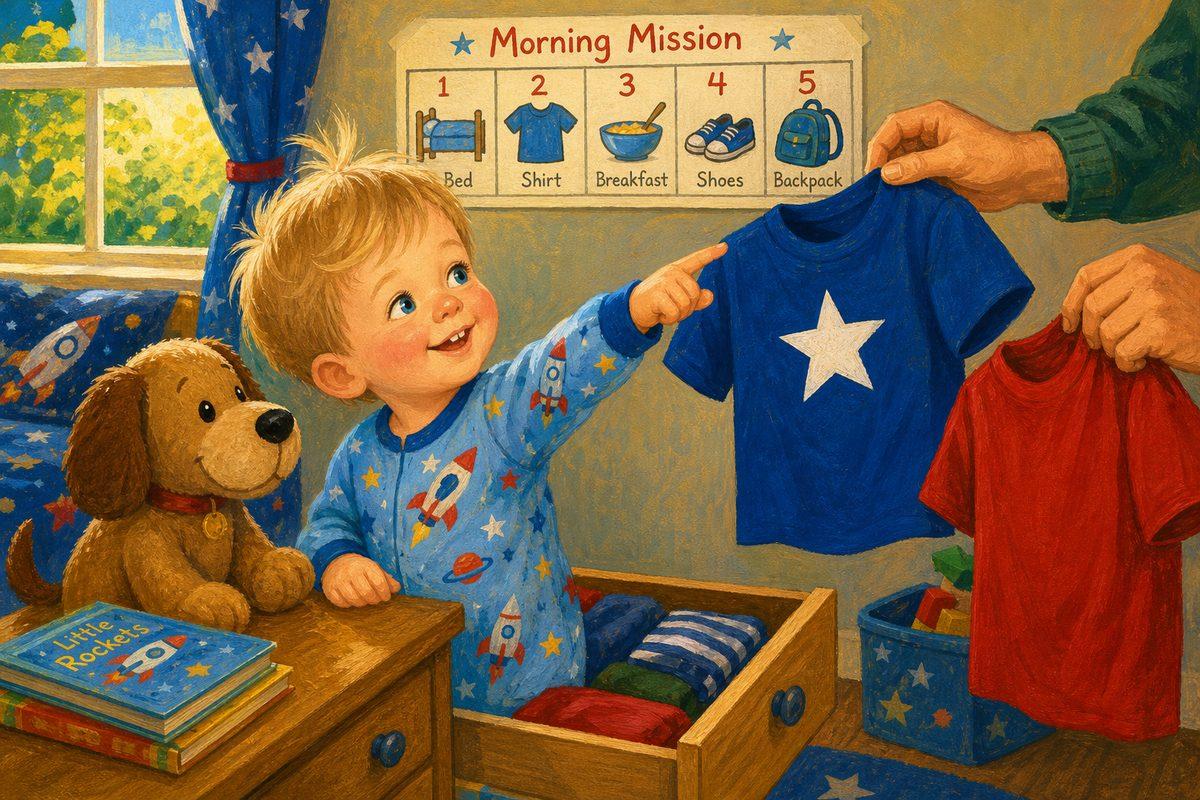

What this story is built to help with: Sequencing and independence — turning the hard, multi-step morning into a mission your child can watch themselves win.
Why a book where your child is the hero makes mornings easier
The stall happens because organizing five steps on the spot is genuinely hard for a young brain. A personalized book gets ahead of that. The night before, your child — by their own name and face — watches themselves do the exact morning that trips you up: they blink awake, pick the shirt, power through breakfast, click the shoes, and make it out the door. They live the whole hard sequence once, from the calm of your lap, and get all the way through it. So when the real 7:45 arrives, the steps aren’t a fresh puzzle to solve under pressure — they’re a mission your child has already run and already won.
Here’s what makes it land. A lovely generic morning book has your child watching some other kid get dressed and out the door — sweet, but it stays “that kid did it.” When the hero is your child, with their name on the page and their own face clicking that second shoe, the story quietly flips. “That character got ready and out the door” becomes “I get myself ready.” That small shift — from watching a hero to being one — is what turns a picture routine into one they actually want to follow, because the kid who beats the morning is unmistakably them.
And the reassurance lands twice. Once from a hero who is your child, doing the hard thing and coming out the other side — and once from you, snuggled up the night before, reading it together and previewing tomorrow side by side instead of racing it at the door. That shared, screen-free minute is the real magic — the together-time that was always the point, never a fix that replaces you. The book is simply the warm, calmer way into a better morning, and it works because you’re in it.

Quick answers
Is it normal my toddler fights getting ready every morning?
Completely. The morning is a multi-step sequence that’s genuinely hard for a young brain — the stall “isn’t a matter of your child lollygagging,” it’s a real struggle with organizing and prioritizing. It’s one of the most common toddler flashpoints, not a sign you’re doing anything wrong.
Why does my toddler refuse to get dressed?
At this age, refusing is often about claiming a little control, not rejecting you. Offering two good choices — this shirt or that one — meets that real need for independence and can actually reduce the pushback.
How do I get my toddler out the door faster without yelling?
“We’re late” means nothing to a toddler — they don’t feel your clock. Swap urgency for concrete countdowns (“in 20 minutes, then 10, then 5”) and a predictable, same-every-day routine so they always know what’s next.
Should I use a morning routine chart?
Yes — a picture strip of the steps, in order, gives toddlers real relief and something to point to. A personalized version where your child is the hero of their own morning makes it a chart they actually want to follow.
What if the real problem is not wanting to go to daycare?
Then the fix lives at the goodbye, not the sock drawer. If mornings are really about the separation ahead, our guides on daycare drop-off and preschool separation anxiety go deeper.
Who’s behind this
I’m Dao — a mom, and the founder of PlotJoys. I make personalized storybooks where your child is the hero, because a book they’re in is the warmest, screen-free way to turn a hard moment — even the morning scramble — into something you get through together. That’s the whole idea: not one more thing to manage before 8am, but a calmer way to start the day, side by side. — Dao
Keep reading
The research, if you want it
- CDC — Essentials for Parenting Toddlers: Tips for Relying on Routines and Rules
- ZERO TO THREE — The Practical Magic of Daily Routines
- Children's Hospital of Philadelphia (CHOP) — Getting Ready in the Morning (EXCEL Clinic)
- ZERO TO THREE — Coping with Defiance: Birth to Three Years
- Child Mind Institute — How Can We Help Kids With Transitions?
- HealthyChildren.org (American Academy of Pediatrics) — Top Tips for Surviving Tantrums