Gift Guide
Non-Toy 3-Year-Old Birthday Gifts: Keepsakes Not Clutter

By Dao, Founder · PhD in mathematics, former Director of Data Science at Uber and Capital One · LinkedIn ↗
The short version
- The connection is the gift. A 3-year-old remembers the together-time around a present far more than the present itself.
- Fewer, better beats bigger. Toddlers focus longer and play more creatively with fewer toys — a keepsake protects their attention instead of crowding it.
- Experiences outlast objects. A membership, a class, or a special outing tends to bring more lasting happiness than one more thing to store.
- A book is a keepsake and a nightly ritual in one — and the most personal version is a story the birthday kid stars in.
The best non-toy birthday gifts for a 3-year-old give together-time instead of more stuff — an experience like a zoo membership or a swim class, an open-ended creative supply, or a keepsake such as a book you read together. The research quietly backs the instinct: toddlers actually play longer and more creatively with fewer toys, and experiences tend to bring more lasting happiness than things. Pick the one gift that makes a moment the two of you will share — that's what a 3-year-old remembers.
First, permission: fewer, better gifts actually help
Here's the reframe most gift guides skip — giving less isn't depriving the birthday kid. In a small lab study of toddlers, the ones handed four toys played longer and more imaginatively than the ones handed sixteen; the bigger pile became a distraction that made them drop one toy to grab the next. (The same researchers noted some homes averaged close to 90 toys per child.) So 'fewer, better things' isn't a compromise — it's a gift to a toddler's focus. Every idea below is chosen with that in mind: one thing worth returning to, not ten things worth forgetting. [3]
Experiences and memberships
A day out beats a toy for the same reason a trip beats a gadget: the joy keeps paying out. Cornell researchers found people get 'more retrospective enjoyment and satisfaction from their experiential purchases than from material purchases' — and even the anticipation of an experience makes us happier than the anticipation of a thing. For a 3-year-old that looks like a zoo, aquarium, or children's-museum membership, a term of swim or music class, tickets to a first kids' show, or a plain old special day out with you. The membership card outlives the wrapping paper by a year. [4]
Keepsakes they'll still have at ten
Some gifts don't get outgrown — they get kept. A stamped growth chart, a dated ornament, a handprint kit, a personalized storybook: these are the ones that end up in the box a family actually saves. A keepsake sidesteps the toy pile entirely and quietly says 'I wanted you to have something that lasts.' It's also the natural bridge to the most personal gift of all, which we'll get to below — the kind of book that doubles as a nightly bonding ritual. [2]
Open-ended creative supplies
Chunky crayons and a big roll of paper. Play dough. A set of blocks. Simple pretend-play props. The reason these age so well is that they grow with the child and pull a grown-up in — the pediatric take is that 'imaginary play is a large part of a child's social and emotional development,' and with open-ended supplies, 'imagination is the key.' A single-function plastic gadget does one thing once; a bucket of blocks does a hundred things over a year — most of them, ideally, with you nearby, because there's 'no screen, video game or app that can replace the relationships built over toys.' [5, 1]
A story or magazine subscription
A kids' story or magazine subscription turns one gift into a small monthly hello all year — and it feeds the single most bonding thing you can do at this age. Shared reading, the AAP notes, 'strengthen[s] the bonds that hold you together and build[s] your child's developing brain,' supporting social-emotional, language, and literacy development at once. It's a non-toy gift that shows up twelve times. [2]
Simple, sensory outdoor play
Not everything has to be an heirloom. Bubbles, a magnifying glass, a little butterfly net, a set of sidewalk chalk — cheap, clutter-light, and pure imaginative fuel. These live outside, don't crowd the playroom, and pull the birthday kid (and you) out into the yard. Same principle as the crayons: open-ended and led by the child's own pretend-play — and 'imaginary play,' the AAP reminds us, 'is a large part of a child's social and emotional development.' [5]
Why a book they star in is the non-toy gift that keeps giving
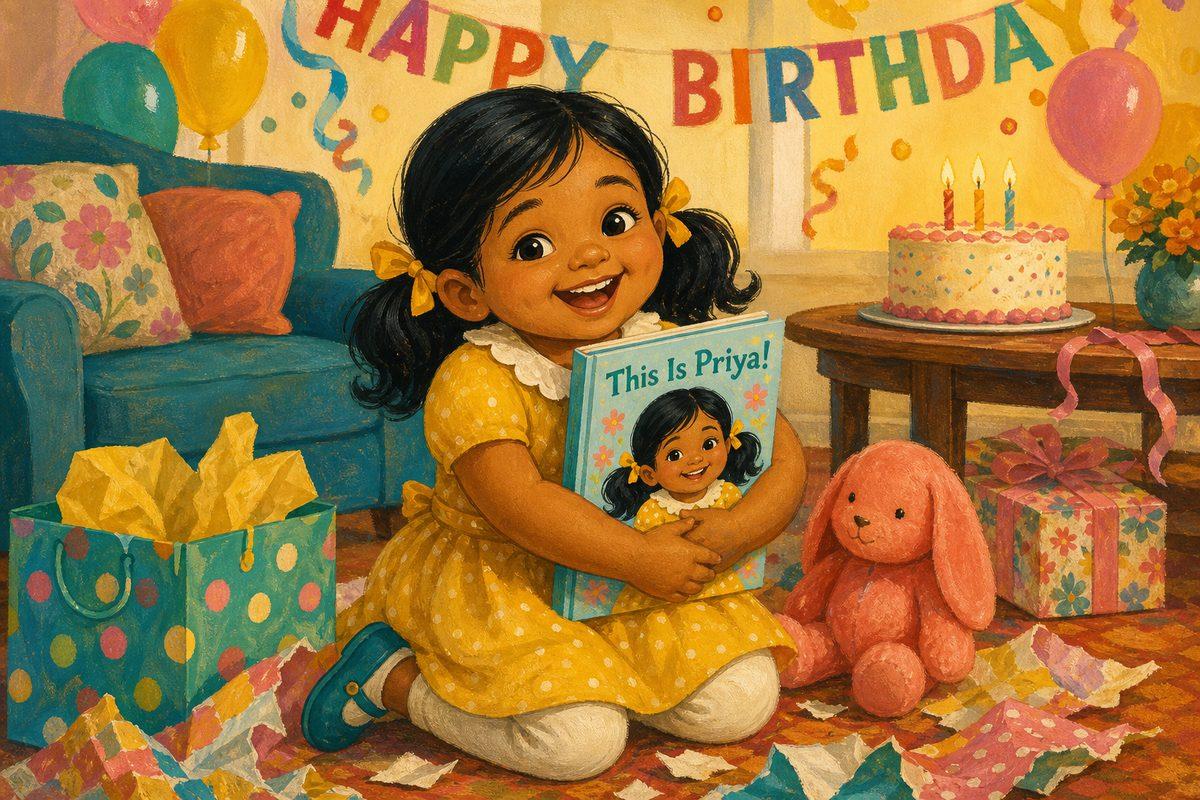
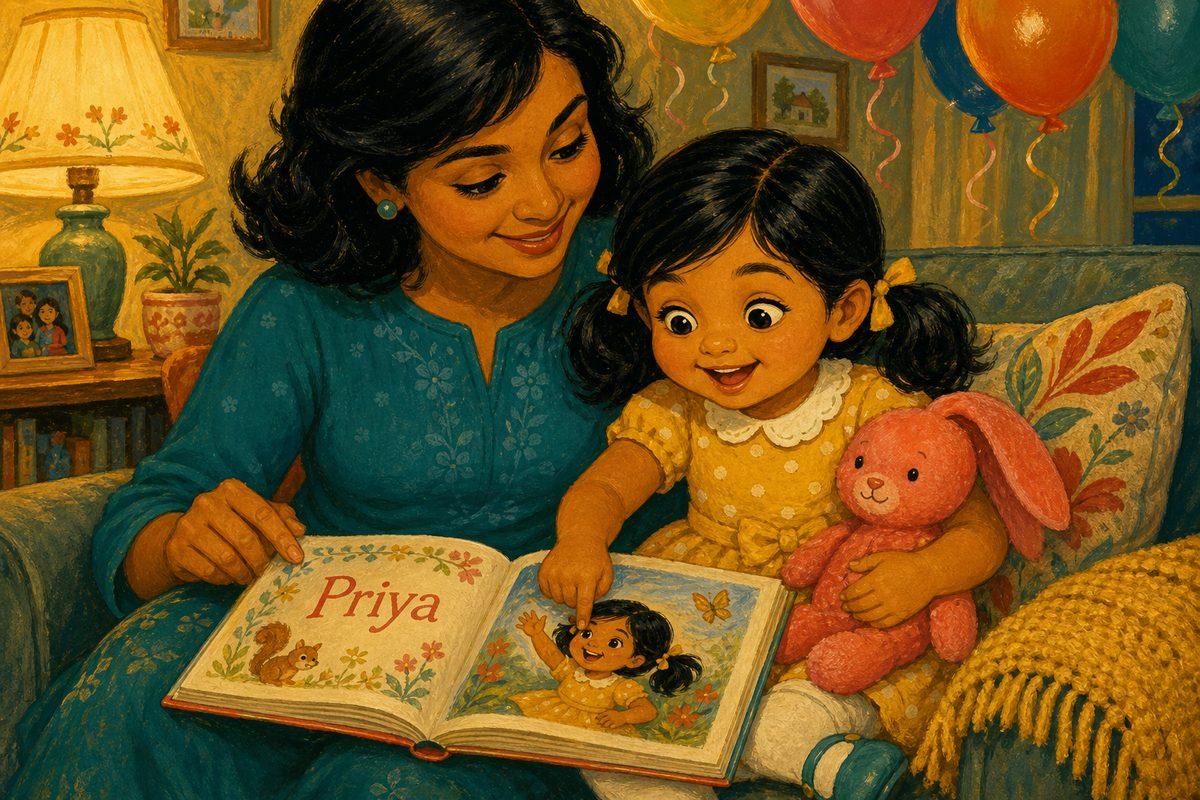
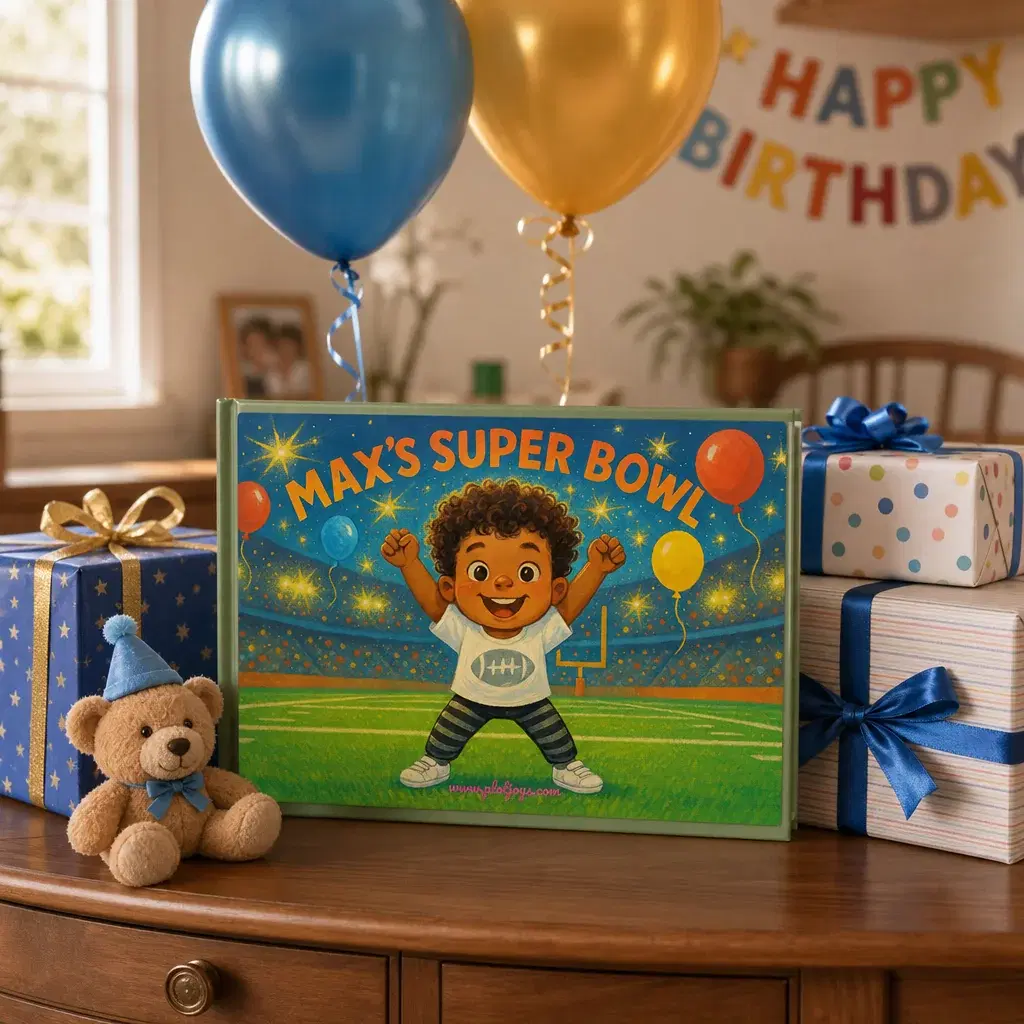
Here's the concrete reason a book they star in escapes the fate of most birthday presents — the one afternoon of excitement, then a shelf. A story where your three-year-old is the named, illustrated hero gets opened at bedtime, and the moment they spot their own face on the cover and hear their own name read out loud, they point and say 'that's me' — and they ask for it again tomorrow, and the night after that. That flash of self-recognition is the engine. It's what turns a one-time gift into a nightly ritual — and the nightly ritual is exactly the together-time a non-toy gift is reaching for in the first place.
A gorgeous storybook off the shelf is a lovely present — but your child is watching some other kid be the hero. A book they star in flips that. The brave one who follows the balloons into the woods, who tries the scary-tall slide, who blows out the three candles — that isn't a stranger with a different name. It's them. Quietly, 'that character was brave' becomes 'I am.' For a three-year-old, whose whole job right now is working out who they are, that's the difference between a nice book and their book — the one they'll never confuse with anyone else's.
And the reassurance lands twice — once from a hero who is unmistakably them, and once from you, on the edge of the bed, reading their name out loud. Shared reading, the AAP notes, 'strengthen[s] the bonds that hold you together and build[s] your child's developing brain.' That's why this is the non-toy gift that lasts: not because it's a clever object, but because it becomes the moment the two of you share, night after night — and the keepsake they'll still find on the shelf at ten. [2]
The book with their name on the cover
Quick answers
What's a good non-toy birthday gift for a 3-year-old?
The ones that give together-time rather than more stuff: an experience (a zoo or museum membership, a swim or music class, a first kids' show), an open-ended creative supply (crayons, play dough, blocks), or a keepsake like a personalized storybook. Pick one thing worth returning to over a pile of things worth forgetting.
Aren't experiences wasted on a 3-year-old who won't remember them?
The lasting value isn't the memory of the event — it's the connection during it, plus the anticipation before and the retelling after. Research on experiences finds people get more lasting satisfaction from things they do than things they own, and a lot of that comes from the shared time, which a 3-year-old feels even if they can't recite it later.
Is it rude to give a keepsake instead of a toy at a birthday party?
Not at all — and you're in good company. 'Non-toy gift' is one of the most-searched things parents look for, precisely because so many are quietly drowning in plastic. A keepsake reads as thoughtful, not cheap; if anything, the parents will thank you for the one gift that doesn't need batteries or a bigger bin.
What non-toy gift lasts the longest?
A keepsake with the child in it — a personalized storybook where they're the named, illustrated hero. Toys get outgrown by the next birthday; a book they star in gets read again and again, then saved. It's the rare gift that's both a nightly ritual now and a time capsule later.
Who’s behind this
I'm Dao, the mom who built PlotJoys. It started at a daycare drop-off and a kid hugging an iPad — I wanted a gift that pulled us closer instead of one more thing to trip over. So we make storybooks where your child is the named, illustrated hero: their face, their name, a story that's theirs. It's the non-toy gift I always wished someone could give me — the closeness of reading together, wrapped up as a keepsake they'll still have at ten. — Dao
Keep reading
The research, if you want it
- American Academy of Pediatrics (HealthyChildren.org) — 'The Best Toys Go Back to the Basics'
- American Academy of Pediatrics (HealthyChildren.org) — 'Beyond Literacy: Shared Reading Starting at Birth Offers Lifelong Benefits'
- Dauch, Imwalle, Ocasio & Metz (2018), 'The influence of the number of toys in the environment on toddlers' play,' Infant Behavior and Development
- Cornell Chronicle (2014) — 'Doing makes you happier than owning – even before buying' (research by Thomas Gilovich & Amit Kumar)
- American Academy of Pediatrics (HealthyChildren.org) — 'Toy Buying Tips for Babies & Young Children' (What to Look for in a Toy)